Lifesum's World Cup Healthy Eating Index Reveals The World's Best Football Nations Are Losing on a Very Different Kind of Pitch - Nutrition

Lifesum's World Cup Healthy Eating Index Reveals The World's Best Football Nations Are Losing on a Very Different Kind of Pitch - Nutrition
London, UK. July 2026—Health and nutrition app Lifesum has analysed match day food logging data across 11 nations competing at the 2026 FIFA World Cup, and the results reveal a striking pattern: the world's best football nations are losing on a very different kind of pitch - nutrition.
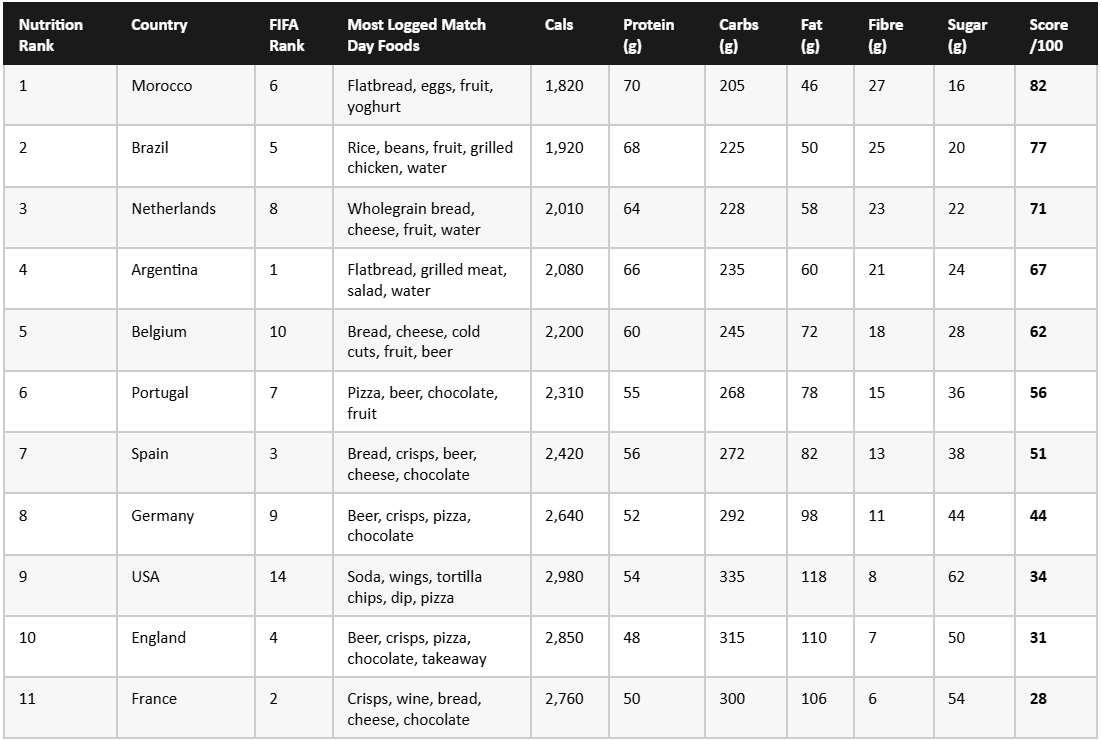
The Lifesum World Cup Healthy Eating Index ranks 11 competing nations by a composite nutrition score built from match day calories, protein, carbohydrates, fat, fibre and sugar intake. The findings turn football's global power rankings upside down.
Morocco, ranked 6th in the world by FIFA, top the nutrition table with a score of 82/100. Brazil (FIFA #5) and the Netherlands (FIFA #8) complete the top three. Meanwhile France, the world's second-ranked football nation, finished bottom with just 28/100. England (FIFA #4) finished 10th. The USA finished 9th.
The data reveals an inverse correlation: the higher a nation ranks in football, the worse its fans eat while watching it.
Victoria Strandlund, Nutritionist at Lifesum, said: "Gen Z are the most nutrition-conscious generation we've ever seen: tracking food, reading labels, downloading health apps in record numbers. And yet our data shows football completely overrides that awareness. In nations like France, England and the USA, the crisps, the beer, the takeaway aren't just snacks, they're part of the emotional fabric of watching the game. Food becomes part of the occasion rather than a source of fuel. Morocco and Brazil are the exceptions. Their fans haven't anchored watching football to a specific nutritional script - food remains food. That psychological freedom is exactly what shows up in the data."
The World Cup Healthy Eating Index - Full Rankings
Key Findings
- An almost inverse correlation - Of the five highest FIFA-ranked nations in the index — Argentina (1st), France (2nd), Spain (3rd), England (4th) and Brazil (5th) — four finish in the bottom half of the nutrition table. France (FIFA #2) and England (FIFA #4) finish in the bottom two. Only Brazil bucks the trend, placing 2nd in nutrition.
- Morocco tops the table (82/100, FIFA #6). Moroccan fans log the highest fibre intake (27g), lowest sugar (16g) and strongest overall nutritional balance of any nation in the index. Having stunned the world at the 2022 World Cup by reaching the semi-finals, Morocco now tops an entirely different kind of league.
- France finishes last (28/100, FIFA #2). The world's second-ranked football nation logs the lowest fibre intake in the index (6g) and 54g of sugar per match day. Wine, crisps, bread and chocolate dominate French match day logs. France's nutrition score is less than a third of Morocco's.
- England 10th (31/100, FIFA #4). English fans average 2,850 match day calories with just 7g of fibre — one of the lowest in the index. Beer, crisps, pizza, chocolate and takeaway define the English match day nutritional profile. England finishes below every other nation in the study except France.
- USA 9th (34/100, FIFA #14). American fans log an average of 2,980 match day calories with just 8g of fibre and 62g of sugar. Soda, chicken wings, tortilla chips and pizza dominate. Despite being co-hosts of the tournament, the USA finishes in the bottom three nutritionally.
- Brazil the exception (77/100, FIFA #5). Brazil is the only top-five FIFA-ranked nation to place in the top half of the nutrition table — finishing 2nd overall. Brazilian fans log strong protein intake, high fibre and consistently lower sugar than their rivals, making them the outlier in an otherwise striking pattern.
"The fibre number tells you a lot," adds Strandlund. "When France is logging 6g of fibre on match day, that's a diet dominated by ultra-processed foods, for example, refined carbohydrates, alcohol and low-nutrient snacks. It's match day as an occasion to abandon nutritional habits entirely. Compare that to Morocco at 27g and you're looking at a completely different relationship with food. Morocco's fans are eating in a way that would sustain them through the match and beyond."
Lifesum's Match Day Nutrition Tips
You don't have to eat like a nutritionist to watch football — but small swaps make a measurable difference to how you feel at full time.
- Boost fibre before kick-off. A piece of fruit, some nuts or wholegrain crackers before the match means you're not running on empty — and less likely to reach for ultra-processed snacks at half time.
- Swap one drink. Replacing one alcoholic or sugary drink with water or a low-sugar alternative makes a measurable difference to match day calorie and sugar intake without sacrificing the occasion.
- Add protein to your snack spread. Eggs, Greek yoghurt, edamame or a handful of nuts alongside your usual match day snacks improves satiety and keeps energy more stable across a 90-minute match.
- Recover well the next morning. A balanced breakfast after a late match — protein, fibre and hydration — restores energy levels far more effectively than skipping meals or reaching for more ultra-processed food.
Notes to Editors
Scoring methodology: The Lifesum World Cup Healthy Eating Index is a composite score out of 100, weighted across six nutritional variables logged by users on match days: total caloric intake, protein (g), carbohydrates (g), fat (g), dietary fibre (g) and sugar (g). Higher fibre, lower sugar, balanced macros and moderate caloric intake produce higher scores. Data is aggregated and anonymised across Lifesum users in each country during World Cup match windows. FIFA rankings referenced are the official FIFA/Coca-Cola Men's World Ranking as of 11 June 2026.
Media Inquiries
Victoria Strandlund, Nutritionist at Lifesum, is available for interviews.
Media contact: Harry Cymbler, Hot Cherry PR, harry@hotcherry.co.uk
About Lifesum
Lifesum is a leading, global AI-powered nutrition platform that helps people make smarter food choices and build sustainable, long-term habits. From improving focus and energy to managing weight and overall well-being, Lifesum provides personalised meal plans, recipes, and AI tracking tools designed to fit modern lifestyles. Learn more at www.lifesum.com.